


When the structure can't come down.
Hydraulic load transfer, active shoring and repairs for buildings that stay in use. In Toronto we took 1,000,000 lbf (4,450 kN) off one column of an occupied 18-storey tower, reading the load live. The residents stayed home.
or call 647-250-7377
WHEN TO CALL US
For the jobs that can't be improvised.
If the drawings say “existing column to be removed and replaced” or “provide temporary support”, call us before the scope is fixed, not after it becomes a change order.

LOAD TRANSFER
A column has to come out under load
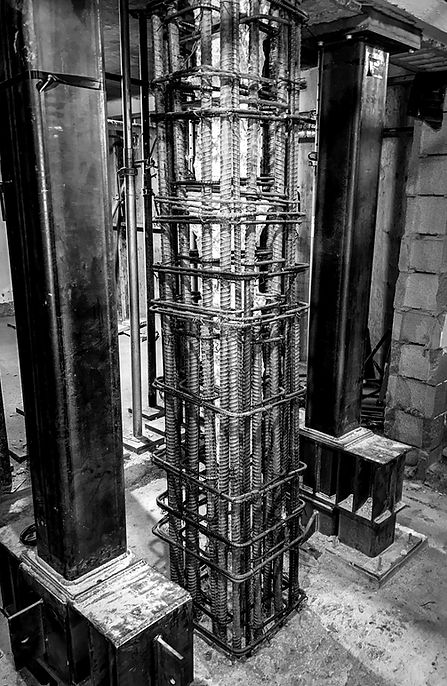
We transfer the load hydraulically to temporary supports, repair or replace the column, then return the load to the permanent structure. The floors above stay in use.
SETTLEMENT AND ALIGNMENT
Something has to
move, precisely
Raising, levelling or holding a structure in position with synchronized hydraulic jacks, with the load and movement at each point measured as it happens.
DAMAGE
Something got hit,
or is corroding away
Impact and corrosion damage in warehouses, parking structures, and other active facilities. Stabilized, assessed, and repaired while the facility keeps running.
ALTERATIONS
A new opening or transfer
beam in an occupied building
Transfer beams, slab openings for stairs, elevators and shafts, and rooftop framing, sequenced with temporary shoring so the floors above stay supported.

THE METHODOLOGY
The team that models the
load path runs the jacks.
Loaded columns in occupied buildings often can't be repaired on passive shoring alone. Active shoring transfers the load hydraulically to temporary supports and measures it, so the repair happens while the building stays in use.

Assess
LiDAR scan of the column and the structure around it. Deformation measured. Load paths and the jacking sequence analyzed in-house.
1
Shore
Shoring brackets fabricated to the as-built geometry. Hydraulic jacks at every transfer point, under synchronized digital load control.
2
Repair
Load transferred. The damaged section is cut out and new steel or rebar is field-welded by our CWB-certified shop. Same team, start to finish.
3
Monitor
Load returned to the permanent structure. The result is checked by scan, and monitoring can stay in place afterwards for settlement and load redistribution.
4
WHAT WE DO
Three specialties.
All of it engineered.
We build and install only what these jobs need, and our own licensed engineers design all of it.
Hydraulic lifting & load transfers
Controlled lifting, lowering, and load transfer for structures that have to stay in service.
Column repair under load.
Levelling/repositioning of buildings, bridges, and heavy equipment.
Load transfer for underpinning and foundation reinforcement.
Synchronized multi-point digital load control.
Specialty temporary works
Temporary works designed in-house and built to LiDAR-scanned geometry.
Active shoring for loaded structures.
Custom brackets and jacking frames.
Temporary support for transfer beams and new openings.
Proof load testing with customized equipment and fixtures.
Repairs in occupied buildings
Structural repairs planned around tenants, operations, and tight access.
Corrosion repair: section replacement, cover plates and splices.
Strengthening of beams and columns.
Moment/shear connection retrofits.
Impact repair.
Repair steel installed in confined spaces.

WELDING IN OCCUPIED BUILDINGS
Welding planned for the building it happens in.
Process chosen for the ventilation, fire risk, and access on site: SMAW, FCAW(g), FCAW(s), MCAW, GMAW or GTAW.
Battery-powered welding equipment where line power or a generator isn't an option: live sites, confined spaces and emission-restricted areas.
Rebar welding to CSA W186, with weldability and carbon equivalent checks on existing reinforcement and custom procedures for unknown or non-standard grades.
Every procedure written and overseen by our CWB-approved welding engineer.
MONITORING


We track the structure while we work on it.
Every lift is measured as it happens. On our Toronto tower job, the readings caught an unbalanced moment when slab framing disengaged from the column during demolition. We analyzed it and rebalanced the jacks.
Robotic total station
Reads prism targets on the structure at set intervals during the work, and each reading is checked against the movement limits in the jacking procedure. It shares a coordinate system with our scanner, so tracked points sit in the same model as the scan.
During the work
Short-term monitoring of jacking, load transfers, staged construction and critical pours, with alert limits set from the design.
After the work
Monitoring can stay in place after hand-back to track settlement, deflection and strain, compared against the analytical model and reported for design files or condition assessments.
Load testing
Proof load tests on anchors, guards and bases, using fixtures we design and build, with acceptance criteria set from code and project requirements.

WORKING WITH FABRICATORS
Specialists, not a steel shop.
Our shop builds what a lift, a shoring scheme or a repair under load needs, and that's all. Routine fabrication goes to partner fabricators, and we engineer our work around theirs. We don't bid conventional steel packages.
WHAT OUR SHOP BUILDS
Shoring brackets, jacking frames and temporary supports 01
Load-transfer steel, paired with hydraulic control 02
Repair steel fitted to scanned, as-built geometry 03
Fixtures for proof load testing 04
Fabricators: bring us in for the part you'd rather not take on.
If your project has a lift, a shoring scheme or a repair under load, we'll engineer and run that scope, and your shop keeps the main steel package. We never bid against you on a job you bring us.
Before you call.
COMMON QUESTIONS

GET A QUOTE
Send us the drawings.
We usually respond within one business day with next steps or a short list of questions.
What happens next
A short call on the structure, access and schedule. A site visit and scan where we need one. A scope and price, and a committed start date.